When I play, I can become deeply immersed in what I am feeling: joy, tenderness, anger, longing, sometimes several emotions at once. Rhythm and movement give me room to explore that complexity before I know how to explain it.
Sometimes the music brings me into those feelings. Learning another artist’s song can introduce me to an emotional world I might not have reached on my own. In improvisation, I might begin with a feeling and discover the music through it.
That relationship made me curious about what happens within the body while we play, and how becoming aware of it might change the experience.
BioSymphony begins with that curiosity. It is an evolving project that translates heart rate variability into generative sound and image in real time.
A working prototype now gives me something to listen to and observe. The next phase is to explore how those responses can enter a live performance, alongside percussion, with breath and movement in development as additional inputs.
Before the research, there was the feeling
As a percussionist, I work with rhythm through touch, movement, and listening. I also experience it internally through my heartbeat, my breathing, and changes in effort and sensation.
My body is already participating before I strike anything.
Paying attention to that raised questions about interpretation. When I feel excitement, how does it enter my timing? When something moves me deeply, what changes in my posture, my touch, or the space I leave between sounds?
I began researching because I wanted to understand an experience I was having. The research gave me more precise questions to bring back to the instrument.
What I mean by “energy”
Musicians use the word energy constantly. A song has energy. A performer brings energy to a stage. The word can hold several things at once: effort, emotion, attention, sound, and movement.
I use it too. But developing BioSymphony asks me to become more specific about what I mean.
There is what I feel while playing. There is what a sensor records. There is what an audience perceives. I am interested in the relationships between those experiences, while recognizing that they do not tell us the same thing.
Part of that exploration led me to HeartMath and its work on emotion, heart rhythms, and physiological regulation. In BioSymphony, that interest takes a practical form: working with heart rate variability data and making choices about how it influences sound and image.
The translation is part of the artwork. It determines what becomes perceptible and what I can respond to.
Learning to listen under effort
These questions follow me into physical training.
Through endurance and strength training, such as HYROX, CrossFit, and Zone 2 work, I pay attention to breathing, pacing, effort, and recovery. I notice what happens when I push too quickly, when I find a sustainable pace, and when I need to adjust.
My body has opinions about all of this. Occasionally, we negotiate.
Drumming brings its own version of that conversation. There is physical demand and coordination, alongside the attention needed to interpret or create music.
In both settings, I am learning to notice my state while I am still inside the effort. I want to recognize unnecessary tension, remain attentive as intensity rises, and retain enough awareness to make choices.
Some days that practice is subtle. Other days it happens during burpees.
That experience informs the questions I bring to BioSymphony. What do I notice through sensation alone? What might I notice differently when an internal process takes audible or visible form?
A palette of emotional states
When I learn another artist’s music, I listen for more than the drum part. I want to understand its feeling. What gives those particular notes their character? What might the drummer have felt while playing them?
I cannot know exactly. Imagining it helps me interpret the music, while allowing my own perspective into the performance.
The song changes how I play. I respond to its mood, its attitude, and the world it creates. Learning a song becomes a way of exploring another state, almost like adding a color to an emotional palette.
In my solo performances and when I improvise, there is more room to follow what I feel and hear where it takes me. Something I play may evoke another feeling, which changes what comes next.
Both processes can happen within the same performance. Emotion shapes the sound; sound changes the emotion.
BioSymphony introduces another relationship to explore: how I might respond musically to physiological changes that I did not consciously direct.
The current prototype
BioSymphony has a working prototype. I use a HeartMath ear sensor to obtain the data used to calculate heart rate variability, or HRV: the variation in timing between successive heartbeats. Those data connect to Ableton Live and TouchDesigner, where they influence sound and visuals in real time.
The focus is on variation between beats and how it can shape an audiovisual response.
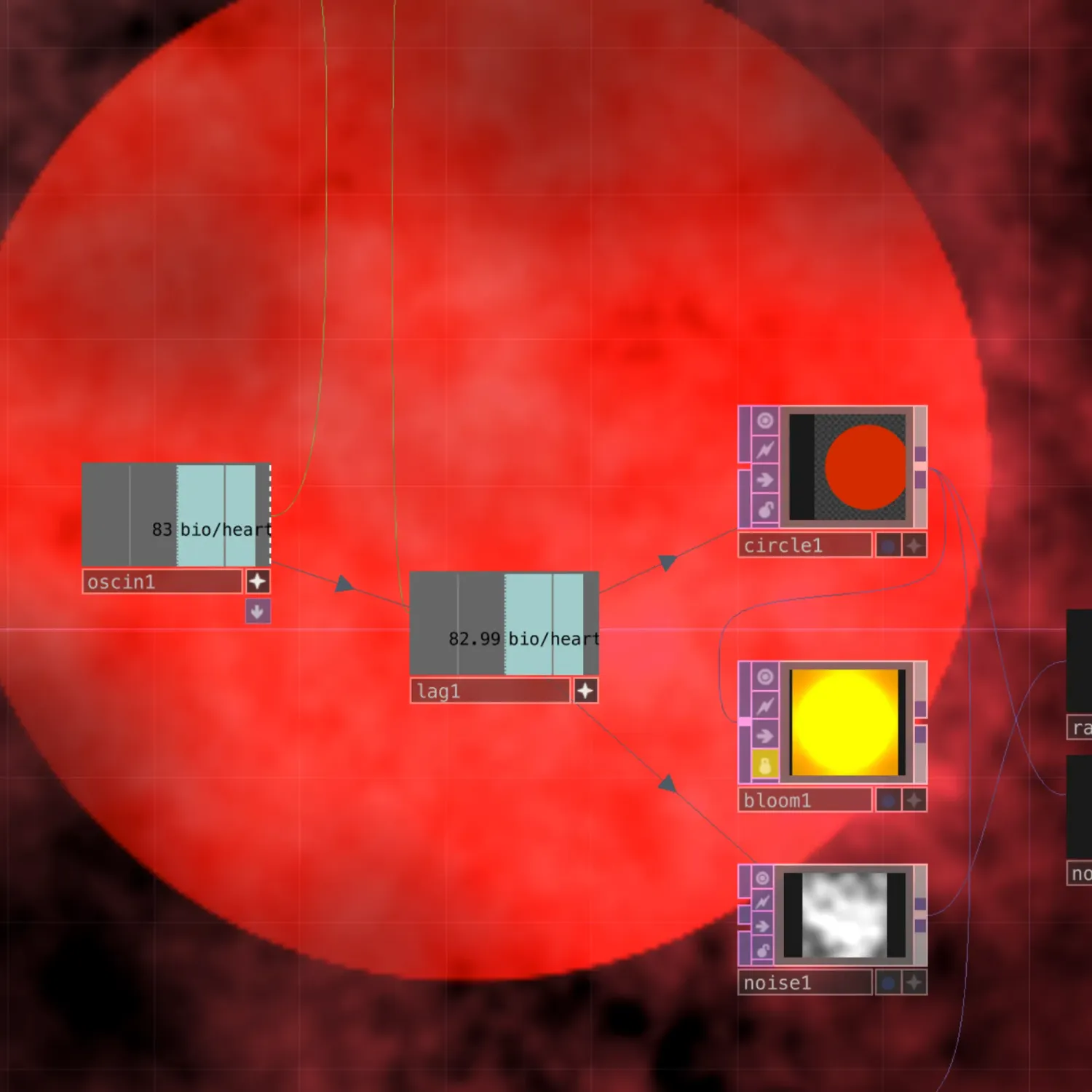
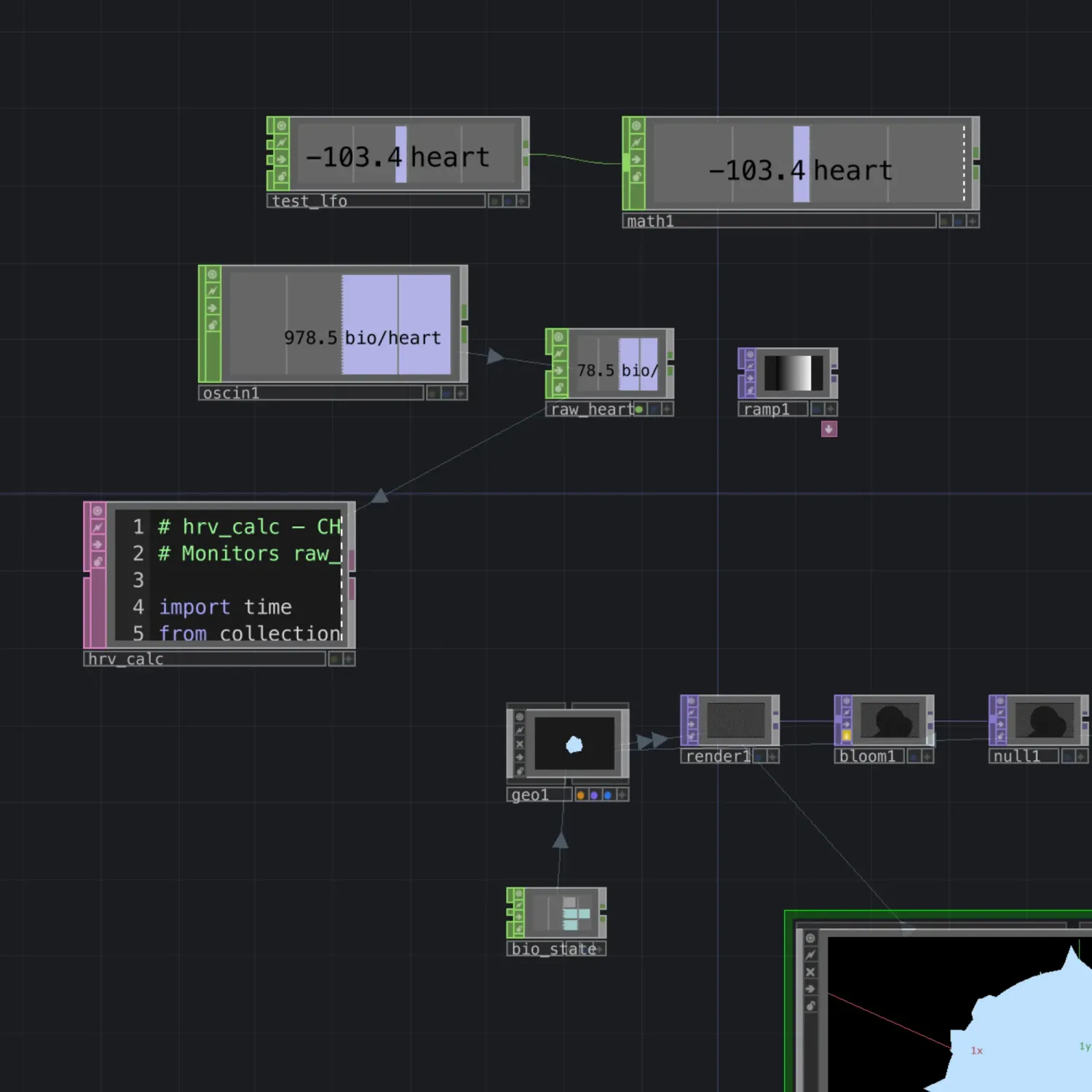
The mappings are artistic and technical choices. A signal does not arrive with an inherent sound, color, or meaning. I decide how it influences the audiovisual environment, then observe what those decisions make possible.
That gives me a way to hear and see an interpretation of physiological activity while noticing my own experience.
The prototype does not identify what I am feeling. My subjective experience and the measured data offer different perspectives on the same moment. Exploring their relationship is part of the work.
Playing within the loop
As a percussionist, I shape rhythms deliberately. BioSymphony asks how I might play in relation to rhythms that arise without a conscious decision.
An internal signal shapes sound or image. I perceive the result. What I hear or see may influence my attention, my playing, or how I experience the moment.
I want to investigate that relationship through rehearsal and performance.
How might I respond when an audiovisual change interrupts an intention? When it supports what I am playing? When I cannot immediately recognize the relationship between what I feel and what the system produces?
These questions also concern the design of the translation. A technically responsive system still needs artistic investigation: whether its changes are perceptible, whether they invite a response, and how much complexity a performer or audience can meaningfully follow.
When words and other people enter
Language and collaboration are further areas I would like to explore through the performance.
A phrase can evoke a memory, suggest an image, or change how I understand a moment. Its rhythm and meaning may influence what I play. I am curious about how spoken language might enter this exchange.
Another musician brings timing, expression, and decisions I cannot anticipate. Their contribution changes the situation in which I am listening and responding.
These remain open artistic questions.
What reaches someone listening?
My attention during performance can be deeply absorbed in the music and in what I am feeling. I notice the audience, but I am not continually watching for a response.
Still, there are moments when something I experience seems to become perceptible to others. I am curious about what they encounter through sound, expression, and movement.
People bring their own histories into a room. What feels joyful to me might awaken something different in someone listening. A shared performance can hold many private experiences.
BioSymphony offers an audience sound and visuals shaped partly by physiological activity. I want to understand what helps that relationship become meaningful to someone encountering the work.
Does knowing where a signal comes from change how someone listens? How much explanation helps? What can remain open to interpretation?
These are questions to explore with audiences as the work develops.
From prototype to performance
BioSymphony brings together interests that have developed through music, research, and training: expression, attention, bodily awareness, and perception.
The working prototype is a starting point. The next phase will refine the relationship between HRV data and its audiovisual expression, explore breath and movement as additional inputs, and develop the work alongside live percussion. EEG is planned for a later phase.
A residency would provide time and space for technical development, rehearsal, collaboration, and audience encounters. I welcome dialogue with people working across biosensing, creative technology, sound, movement, and performance.
What draws me to this work is the opportunity to listen differently to a body I already know through playing.
I want to understand what becomes perceptible through that process, and how it might change the choices I make as a musician.
By Mila Tina.