Before it had a name, it had a need: more room to move.
I was playing drums sitting down, and I kept wanting to get up.
I wanted to move with the rhythm, to let an emotion carry me across the space instead of keeping it contained behind the kit. Dance and martial arts were already part of how I expressed myself. I wanted to bring that whole vocabulary into the music.
So I began rearranging things.
I brought together my favorite acoustic and electronic percussion instruments, with timbales taking the lead. I positioned the cymbals so that a martial arts gesture could extend into a strike, giving the movement both a sound and an impact. I built the arrangement myself, around what I wanted to express.
Apparently, some of my artistic questions required moving furniture. And cymbal stands.
That setup became my playground.
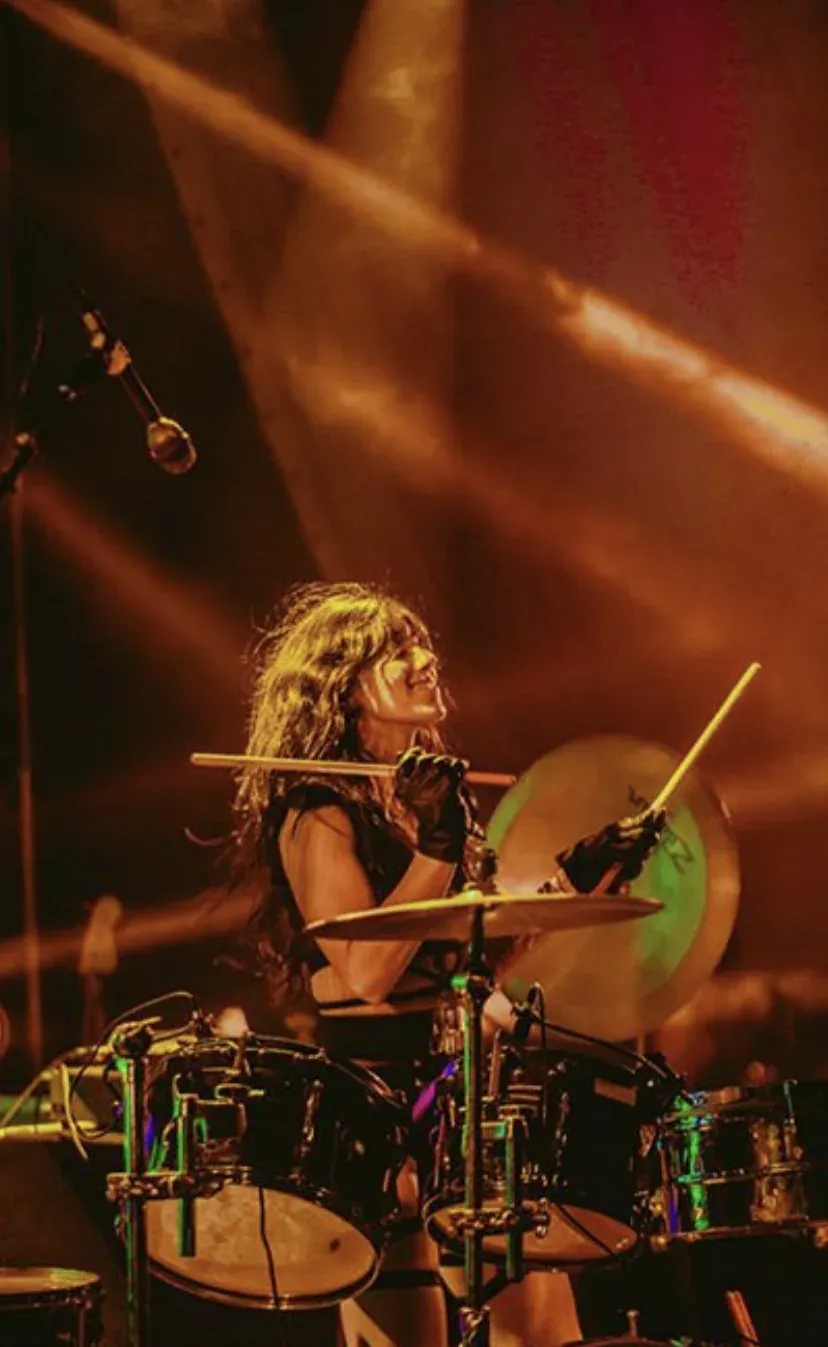
Making room for the whole body
There is something revealing about arranging a space around the way you want to move. You begin to notice which gestures come naturally, where you feel restricted and what becomes possible when you change the distance between things.
For me, standing opened up another way of playing. I could travel with a phrase, give an emotion weight, let a gesture continue beyond the moment of contact. The rhythm had somewhere to go.
Percussion, dance and martial arts met through timing, precision and release. A movement could become a sound. Hearing that sound could change the next movement. With video and lighting, I could build a world around that exchange.
I was making a space of my own, then learning what I could express inside it.
Before the performance had a name
On April 2, 2016, I performed at Guild Hall for OLA of Eastern Long Island’s Soy María, Soy Mujer. I had been invited to portray women’s stories through live drumming, music composition, video and dance.
That performance marked my beginning as a solo artist. The set did not yet have a name, but the questions were already there.
How do I find my own voice? What do I do with everything I feel? How much of who I believe I am comes from expectations I have inherited, and how much have I allowed myself to discover?
I could explore those questions through a performance before I knew how to explain them in a conversation. Sometimes the body gets there first. The explanation arrives later, carrying books.
Becoming my own heroine
As the work developed, Maureen Murdock’s The Heroine’s Journey: Woman’s Quest for Wholeness gave me another way to understand what I was exploring.
The feelings and artistic impulses were already there. Her framework helped me recognize relationships between them and find language for the work. Research became a way to look more closely at something I had begun through intuition and experience.
The idea of becoming my own heroine resonated with me. It meant taking responsibility for the direction of my life, trusting my voice and allowing myself to make choices without waiting to feel completely certain.
And then there was that word: wholeness.
For me, it made room for the parts of myself that did not fit neatly together. Strength and vulnerability. Tenderness and anger. The desire to be seen and the fear of being seen. I could experience all of those things without treating one as evidence that another was false.
That complexity belonged in the performance, too.
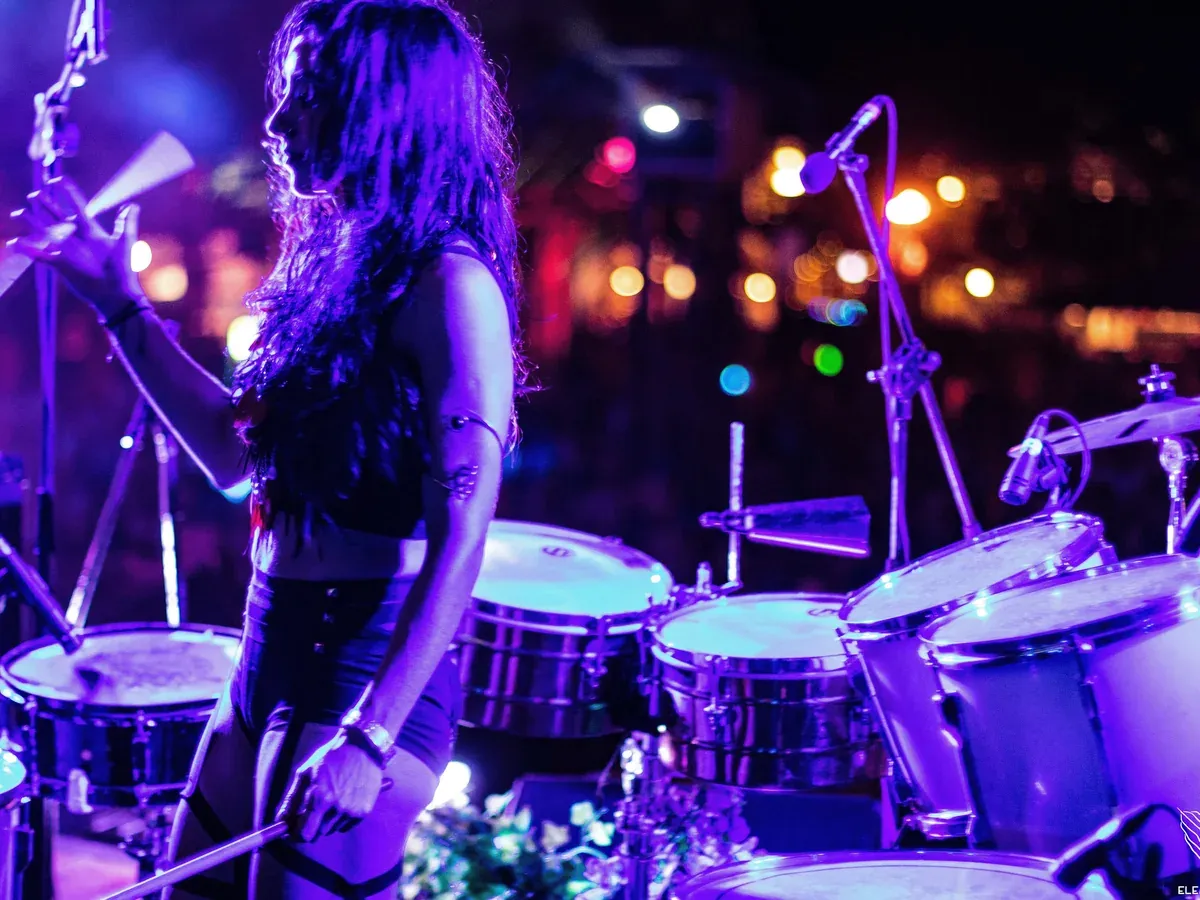
A space to become
Through drums, movement and video, I could give those different states a physical form. I could explore their intensity, their contradictions and the transitions between them.
The standing arrangement became part of that exploration. Its design began with a simple desire to move, but it also asked a question I kept returning to in other areas of my life: what could change if I allowed myself to make the space I needed?
Across theaters, festivals and outdoor stages, the work continued to develop. Each setting offered different dimensions, different possibilities for movement, different ways for sound and image to meet.
The setup was mine. What I could discover within it remained open.
The journey continued
The Heroine’s Journey eventually evolved into Mujer Luna, through film, a new live performance and original music. My research expanded, and I found further perspectives for understanding and expressing the questions that had brought me to the drums.
I still return to the relationship between acceptance and change. Can I recognize who I am today without making that identity a limit? Can I allow myself to become someone I cannot yet fully describe?
In this work, those questions began with something very practical.
I wanted to stand up.
Then I wanted to see where the rhythm could take me.
By Mila Tina.
Envision Festival photograph: Elementalism.