How much of ourselves remains hidden because there is little room for it to appear?
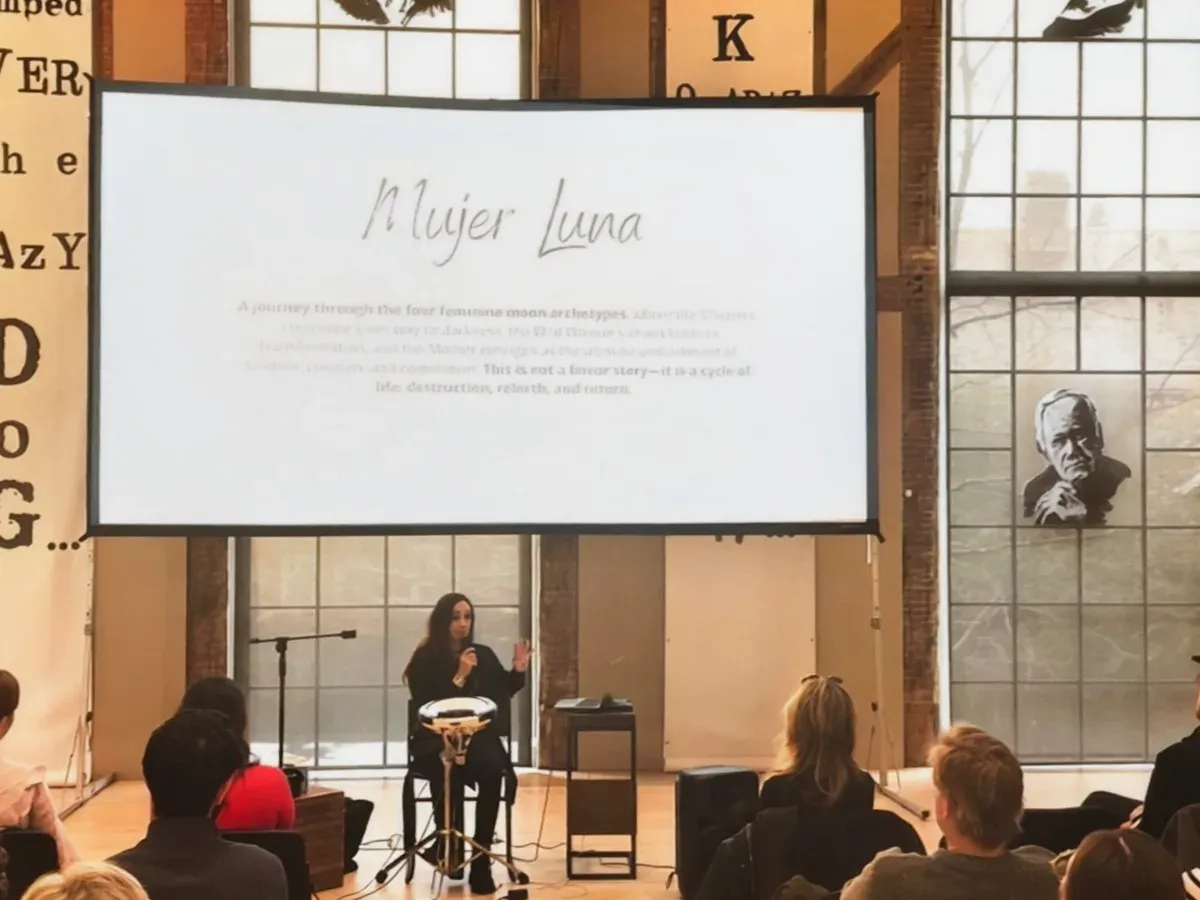
On February 16, 2025, I presented Mujer Luna at The Church in Sag Harbor for Insight Sunday. During my artist residency, which ran from January 30 to February 19, I shared the film, performed on my Wavedrum and opened a conversation about the ideas behind the work.
We talked about mythology, feminine archetypes, rhythm and the body. People brought questions about creativity, aging, anger, rest and the expectations we carry.
At the center was a question that continues to shape my work: how do we make room for the complexity of feminine experience, within ourselves and within the environments we inhabit?
Creating my own playground
During the conversation, I shared how I found my way to the drums.
I started as a singer, but rhythm had caught my attention long before that. As a kid, I’d tap along to the sound of a moving train, a ticking clock, anything with a beat. A classmate I respected once told me I’d never become a drummer because drumming was for men. For a while, I believed him.
Anyway… here we are. With a lot of drums.
Later, while singing in a Latin band, I kept finding my way toward the percussion. I would ask to play the timbales for a song. The more I played, the more I wanted to explore.
Eventually, playing seated felt too contained for what I wanted to express at that time. I wanted to move with the rhythm, to carry an emotion through the space.
So I created my own playground.
I assembled my favorite acoustic and electronic percussion instruments into a standing arrangement, placing them where I wanted to move, reach and strike. I positioned the cymbals so that a martial arts gesture could carry through into a sound.
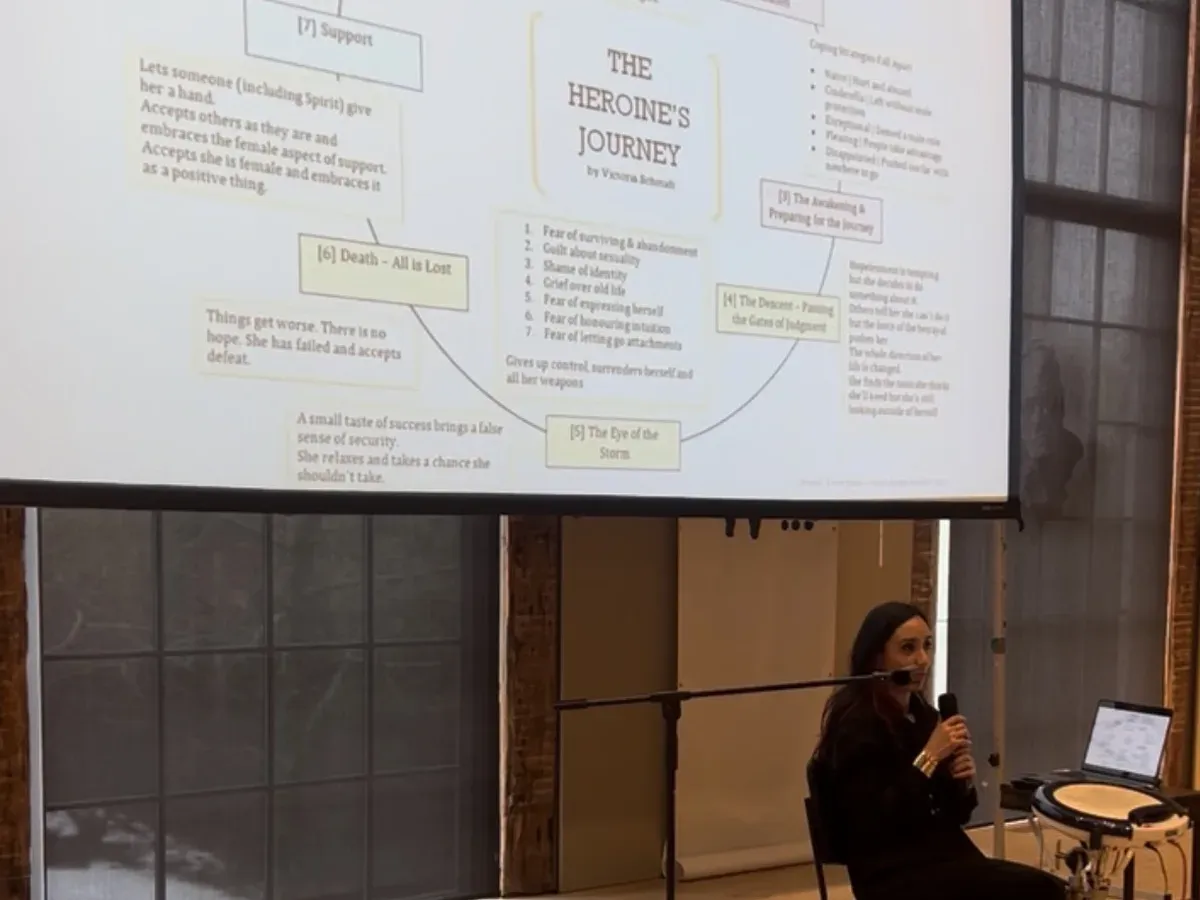
That arrangement became central to The Heroine’s Journey. Through drums, dance, martial arts and video, I could give different emotional states a physical form. I could be tender, angry, playful or intense, and build a space that allowed those expressions to coexist.
From a full setup to a single instrument
Mujer Luna grew out of that exploration, but its form changed considerably.
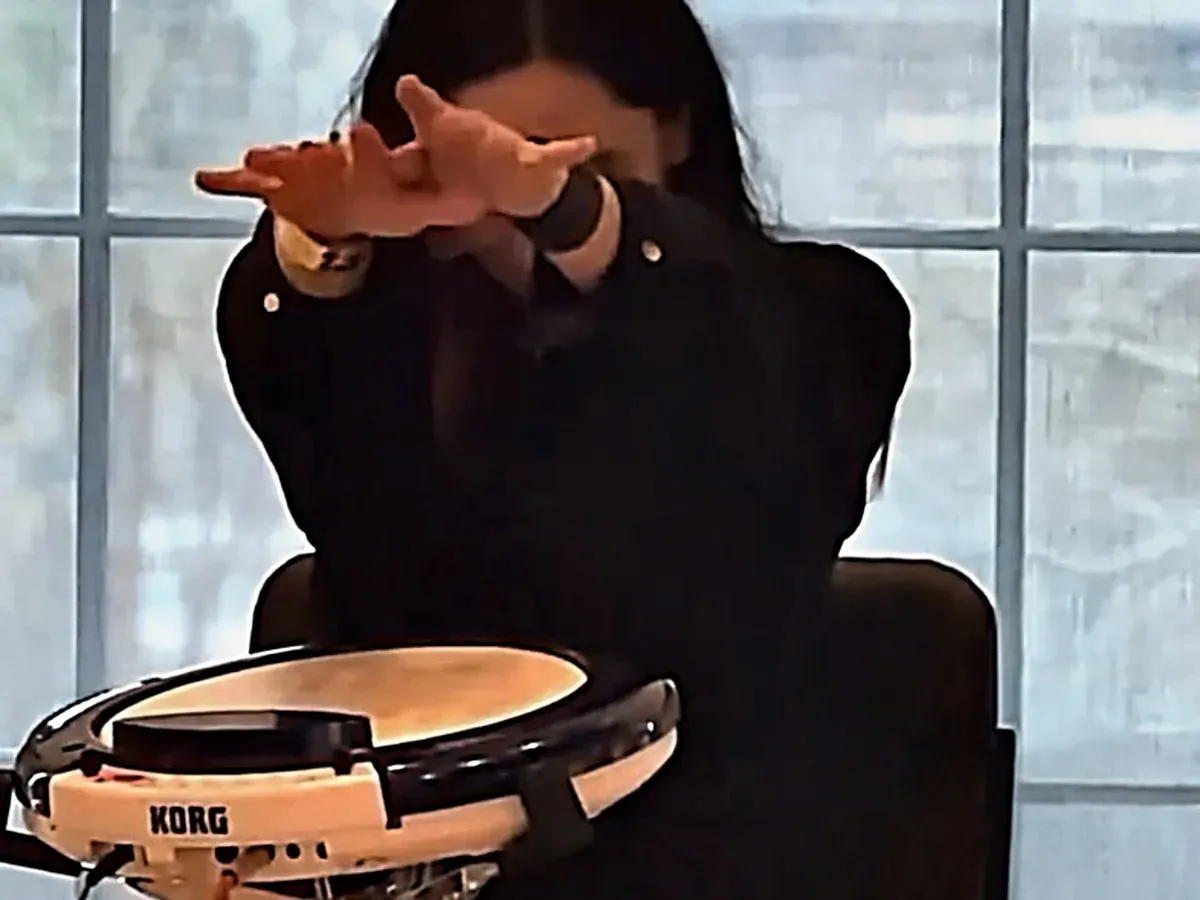
For this work, I sat down with a single electronic percussion instrument: the Wavedrum. The focus shifted toward the film and sound, with my live playing in conversation with the images.
What I had explored through movement across a stage could now unfold through film, editing and musical expression. The physical setup became smaller, while the screen opened another space for the work’s emotional complexity.
There is a little irony in building an entire standing setup because you want to move, then finding yourself seated again. But the work was asking for a different kind of attention.
The feeling came first
Mujer Luna means “moon woman.” The Moon became a way to explore feminine identity, cycles and the relationship between what is visible and what remains unseen.
I think of the “dark side of the moon” as a metaphor for dimensions of ourselves that do not always have room to appear. Some are private. Others are difficult to articulate, or have been met with enough discomfort that we learn to keep them to ourselves.
A partial view can become the version of us that others expect to see.
As the film evolved, research offered further ways to understand and shape what I was creating. Someone in the audience asked about that relationship: had the emotional experience come first, or had the conceptual frameworks inspired the work?
The feeling came first.
I began by experimenting, playing what I felt and following the rhythms that arrived. My curiosity then led me toward storytelling, mythology and the heroine’s journey. Those ideas helped me recognize connections and articulate experiences I had already begun expressing.
For me, composition often begins with rhythm. A pulse arrives, and I build around it. It becomes something like a heartbeat, giving the work its momentum.
Finding the heroine’s journey
When I first learned about Joseph Campbell’s hero’s journey, I began recognizing its structure in films: the call to adventure, the challenges, the transformation, the return. Suddenly, watching a movie came with a little voice in my head predicting what would happen next.
But I also felt that this framework left aspects of my own experience unexplored.
Then I encountered Maureen Murdock’s The Heroine’s Journey: Woman’s Quest for Wholeness. Murdock developed her model in response to Campbell’s, seeking to address dimensions of women’s psychological and spiritual experience that she felt his model did not adequately encompass.
Her work gave me a way to consider the pursuit of recognition within patriarchal systems, the disconnection that can accompany it, and the recovery of qualities we have learned to devalue.
I recognized questions I had already been carrying: What have I pushed aside to belong? Which parts of myself have I learned to distrust? What would it mean to acknowledge them?
We also talked about archetypes: recurring symbolic figures and patterns that offer ways to explore human experience. In my work, they give form to qualities such as innocence, independence, anger, care and creativity.
I approach them as possibilities for expression. A person can recognize herself in several figures, or move between them. There is more to a woman than any single role can hold.
Persephone and the descent
Several people in the room were unfamiliar with Persephone’s story, so we spent time with it.
In the ancient Greek Homeric Hymn to Demeter, Persephone is gathering flowers when Hades abducts her into the underworld, with Zeus’s permission. Her mother, Demeter, goddess of agriculture, searches for her. In grief and anger, Demeter prevents crops from growing, and famine threatens the world.
Zeus eventually sends Hermes to bring Persephone back. But having eaten the pomegranate offered by Hades, she must return to the underworld for part of each year. Her reunion with Demeter allows fertility to return to the earth.
The story holds separation, grief, power and return. I connected with the movement between worlds, and with the experience of entering a place where familiar answers no longer work.
In Mujer Luna, descent offers a way to approach an internal world that can be difficult to reveal. What happens when the feelings we carry exceed the roles we have been given? Where can those feelings go?
During the conversation, I spoke about a period of deep discouragement in my own life, when my relationship with music became difficult. There was anxiety, anger and the pain of wanting to express myself without feeling I had the space to.
Creation gave me a place to encounter those experiences. I could listen to them, work with them and make choices about the environments I wanted to inhabit.
Rhythm, rest and the environments we live in
Our conversation also moved toward the body.
I shared ideas I had been exploring through Dr. Kayla Osterhoff’s work and the questions they raised for me about hormonal cycles, self-awareness and the ways we organize our lives.
We talked about changes in energy, the need for rest and how difficult it can be to honor those needs when the expectation is to keep producing at the same pace.
Many of us carry several roles at once. We work, care for people, maintain relationships and respond to other people’s needs. Then, when we need to pause, guilt can arrive before rest does.
I wanted to question that expectation.
When we talk about exhaustion and burnout, I want us to examine the demands around us, too. How much control do we have over our schedules? Can we set a boundary without being judged? Does our environment give us room to respond to what we need?
Several women in the room had not considered their working lives from that perspective.
For me, paying attention to my own patterns has changed how I approach work, creativity and physical training. There are times when I feel ready to push, experiment or be social, and others when I need quieter activity and rest. Recognizing those differences helps me respond with less guilt. Someone else’s patterns may be different.
I used the image of winter during the conversation. We recognize that season in nature, but allowing ourselves a quieter period can feel much harder.
We need winter, too.
Part of my research is exploring how we could create environments that make room for different bodies, cycles and experiences. I want women and men to work better together, with more understanding of what each person brings and needs.
That requires attention to how our systems are organized, alongside awareness of ourselves.
The questions the room brought
One audience member brought another dimension into the conversation: age.
She described the freedom and creative energy she experienced as an older woman, including feeling less afraid to express anger or challenge inequality. She asked how those experiences fit into a discussion centered on menstrual cycles.
Her question widened the conversation. Different stages of life bring different relationships with the body, different pressures and different freedoms. An exploration of feminine complexity needs room for those experiences, too.
Another question concerned the cycles in my work: were they literal or symbolic?
I explained that much of the imagery is symbolic, even when the experience feels intensely physical. Destruction can represent the release of an expectation or identity. Descent can give form to uncertainty, or to an encounter with something we have avoided within ourselves.
These images let me approach experiences without reducing them to a single explanation.
Structure, freedom and the way I play
We also talked about qualities I describe in my art as feminine and masculine, and how I experience both. I use those terms symbolically in this context, to explore qualities that can coexist within a person.
Music gives me a practical way to consider that relationship.
When I play drums with a band, I hold a pulse that supports everyone. There is structure and responsibility in that role. During the talk, I compared it to driving a truck. You have to keep it moving.
In my solo work, or when I improvise on percussion, I have more room to respond moment by moment. I can move around the pulse, follow a musical idea or let a rhythm arrive without knowing what will come next.
Sometimes it feels like speaking through the drum.
Both experiences belong to my practice. I enjoy the relationship between structure and freedom, between holding something steady and discovering what can happen around it.
Ending with creation
I explained that I deliberately chose to end Mujer Luna with the Mother, with creation and the possibility of bringing something into being.
For me, that creative capacity extends to music, art, projects, relationships and the environments we build. It asks what we might nurture, and what conditions would allow it to exist.
We also talked about wholeness. I understand it as making room for parts of myself I once felt I had to hide: anger, tenderness, uncertainty, intensity and joy. They can exist together without becoming a tidy, consistent account of who I am.
The film and music give me a way to bring them into the same work.
What stayed with me after Insight Sunday was how the conversation kept expanding. People recognized something, questioned something, or brought an experience that complicated my own perspective.
Mujer Luna continues to evolve through that exchange. The film gives form to an internal world; the conversation opens it to other lives.
And the question remains: how much more might we understand about one another if we made room for the parts we do not usually get to see?
Credits: Mujer Luna by Mila Tina. Presented at Insight Sunday, The Church, Sag Harbor, February 16, 2025, during her January 30–February 19 artist residency.